
For years, HR leaders have carried the weight of succession planning on their shoulders. They’ve built competency models, held calibration meetings, chased updates from leaders, and tried to orchestrate development conversations across the entire organization.
But the world of work has changed. The expectations on HR have changed. And most importantly, the velocity of business change has made the old model of HR-owned succession planning unsustainable.
That’s why more forward-thinking organizations are embracing a new approach: The Key Role Owner (KRO) Model.
The KRO Model reframes succession planning as an operational discipline owned by leaders, not a task managed exclusively by HR. This shift is giving HR teams the freedom they’ve been asking for: less administrative burden and more capacity to focus on strategic talent decisions.
👉 Download the Key Role Owner (KRO) Guidelines & Candidate Assessment Framework
Most HR teams today would tell you the same thing: succession planning doesn’t fail because HR doesn’t care. It fails because HR is too far away from the real work.
In a typical model, HR is expected to:
The irony? HR ends up responsible for work they cannot realistically see, monitor, or influence on a daily basis. The KRO Model flips that dynamic.
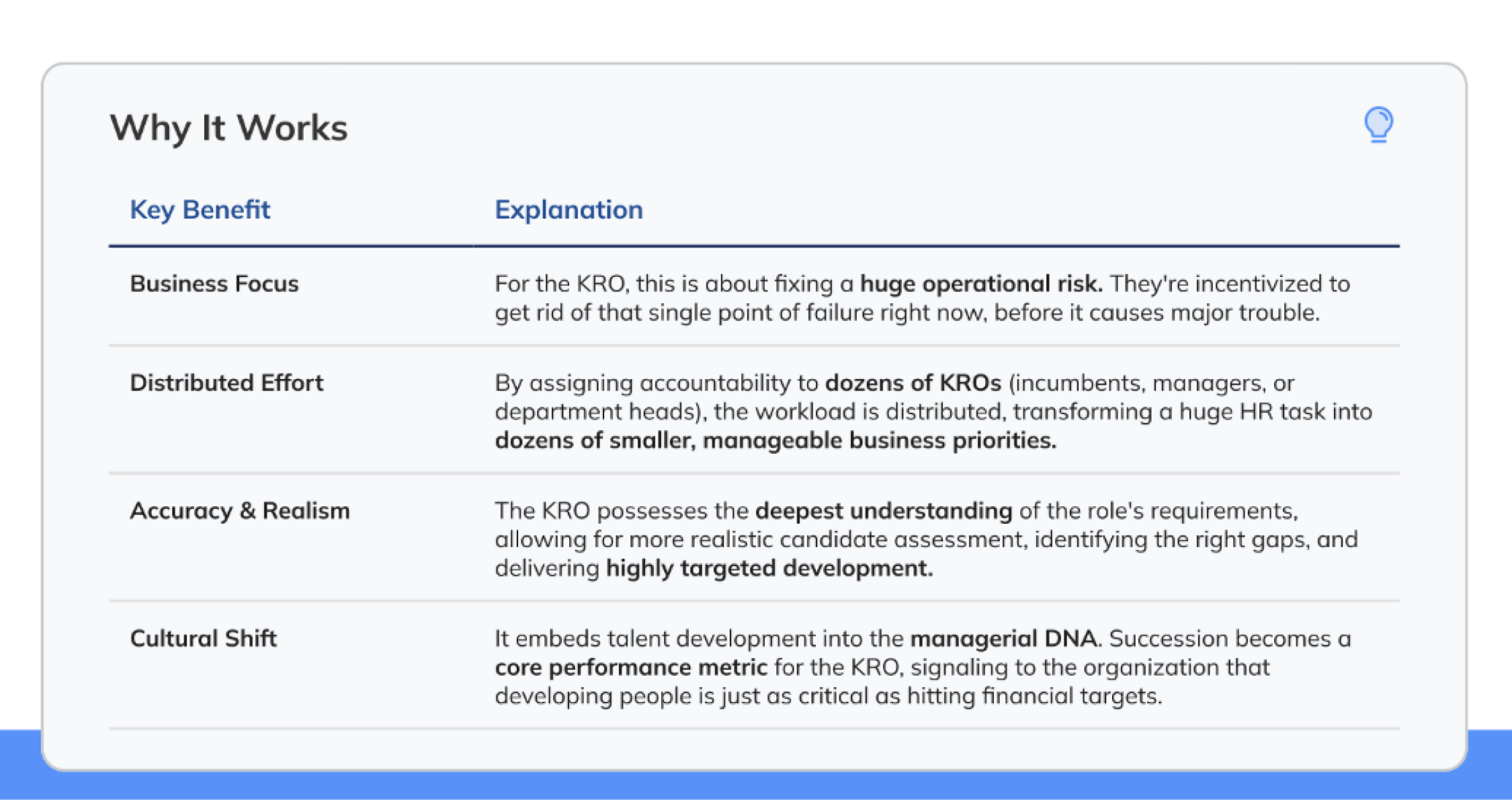
The power of the KRO Model isn’t just that it “delegates work”; it locates accountability where expertise actually lives. A Key Role Owner is the person in the organization who best understands what success in a specific role looks like. It may be the incumbent, the incumbent’s manager, or a department leader.
And when the right person owns the role:
👉 Get the Assessment Tool and give every Key Role Owner a clear, structured way to evaluate candidates and track readiness.
Three major shifts are pushing organizations toward this model:
HR is now expected to think about workforce planning, leadership capacity, internal mobility, equity, engagement, and emerging skill needs. You simply cannot take on all of that and still be the sole owner of role-level succession planning. The KRO Model frees HR to focus on patterns, not paperwork as it moves HR from project manager to strategist.
Organizations talk a lot about “developing people,” but for many leaders, it’s still an implied responsibility instead of an explicit one. The KRO Model changes that. It makes talent-building a core leadership behaviour which then becomes visible, measurable, and expected.
Even when HR defines the Key Role skills, the context around those skills shifts quickly. KROs are closest to the work, giving real-time insight into how those skills show up in practice. This keeps readiness assessments and development plans aligned with what the role requires today.
The KRO Model doesn’t remove HR from succession planning; it elevates HR’s role.
Instead of doing the assessments, HR defines the standards, ensures accountability and equips KROs with the tools to do it well.
HR becomes the engine behind:
This creates a system where leaders drive the work, and HR drives the quality of the work.
For the model to work, KROs must feel confident and equipped, not overwhelmed. Organizations can support them with:
📘 Download: The KRO Model & Assessment Framework and uncover everything KROs need to run accurate assessments, guide development, and hold meaningful talent conversations.
When they are properly equipped, KROs become powerful agents of leadership continuity rather than reluctant participants.
The KRO Model works because it distributes ownership, reduces risk, and finally allows HR to lead from the strategic level. It aligns talent planning with business reality and embeds development into the fabric of everyday leadership.
Most importantly: It makes succession planning sustainable.
Organizations that adopt the KRO Model aren’t just modernizing their process; they’re building a leadership engine that can support growth, transitions, and change for years to come.
And for HR teams? It’s the model that finally lets them stop managing details and start shaping the future.
Start enabling your Key Role Owners today.


